
A Decade of Referral Research: What Really Works and How Are Things Changing

For more than a decade we have researched the drivers of referrals and helped countless firms uncover and respond to the untapped referral opportunity in their business.
We know that referrals are not the starting point but an outcome of delivering an engaging experience. But we also know that activating – and maximizing – that referral potential still requires intentional action.
The firms that generate the most referrals:
1. Understand clients deeply
2. Communicate how they help clients solve meaningful problems
3. Build confidence in their financial future
4. Create highly engaging experiences
5. Make it easy for clients to connect friends and family
You can access the our latest research in the 2026 Client Intelligence Monitor here.
Going back over a decade, three themes endure.
- Clients refer to help others, not to help advisors
The most foundational finding across Absolute Engagement's referral research is that clients refer to help friends and family rather than their advisor. Their motivation is fundamentally altruistic – they want to help friends solve their financial problems. This insight has remained consistent across more than a decade of investor research.
To drive referrals advisors need to help clients understand the problems they solve, in terms that friends and family actually use when speaking to one another.
- The referral gap is much larger than most advisors realize
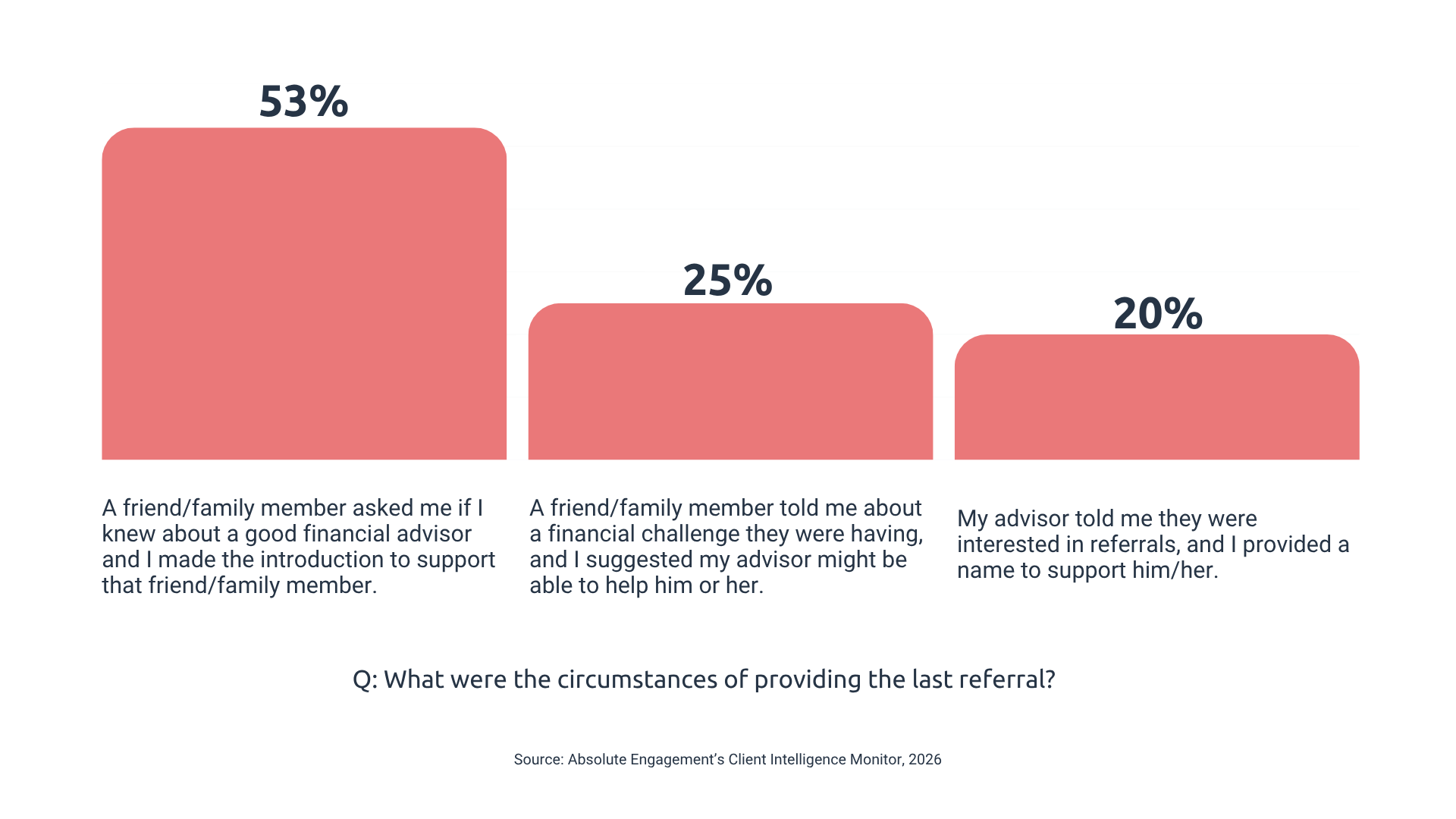
Our research shows a significant disconnect between the number of referrals clients believe they make and the number of referrals advisors actually meet. In 2026, 42% of clients reported making a referral, and yet advisors report meeting referrals from only about 4% of clients.
The reason is simple: many referrals are nothing more than a casual mention.
These are referrals, but they are not introductions. Only a small percentage result in a direct connection between advisor and prospect.
The low hanging fruit is focusing less on generating more referrals and more on converting existing referrals into introductions.
- The most common referral tactics don’t reflect referral behavior
Despite the fact that many advisors say they “should ask for more referrals more often” this may not be the case. For many years we have seen that the impact of asking is limited.
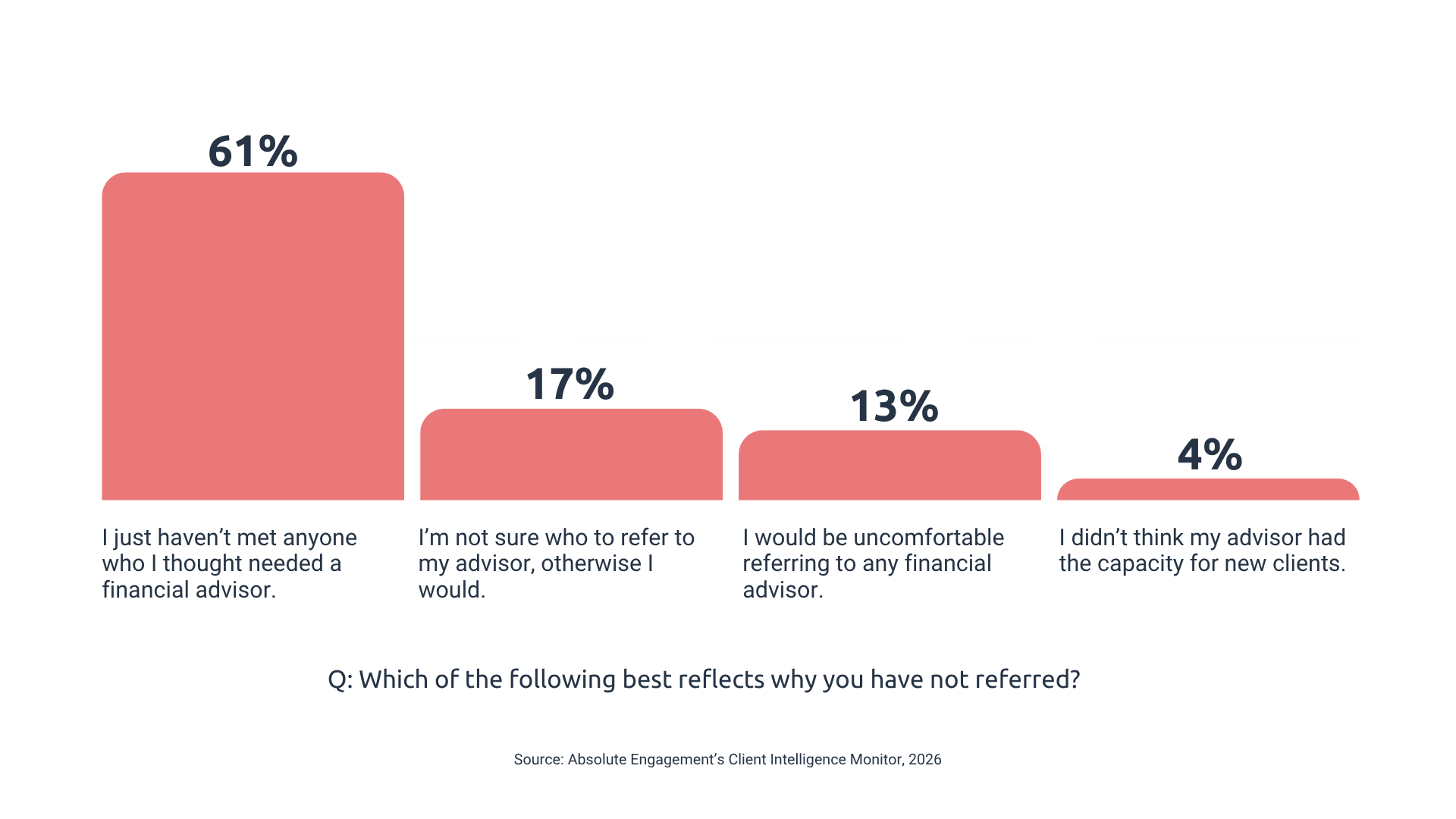
The biggest barrier is not dissatisfaction or reluctance to advocate. Clients simply don’t know who to refer.
The death of standalone referrals
Recent research is also shedding more light on driving referrals, particularly when it comes to the connection between referrals and digital marketing.
One of the most important referral lessons to emerge in recent years is that referrals rarely happen because of a single interaction. Research conducted by Ficomm Partners, in partnership with Absolute Engagement, found that investors who discover an advisor through multiple touchpoints are far more likely to become referral advocates themselves.
According to Ficomm CEO, Meg Carpenter, clients may hear about an advisor from a friend, but increasingly they validate that recommendation through a website, social media presence, online content, media mentions or other digital channels before taking action. The same pattern appears to influence future referral behavior. Clients who engage with an advisor through multiple touchpoints develop a deeper understanding of the firm's value and are more likely to become advocates. For firms focused on growth, the implication is clear: referrals should not be viewed as a standalone initiative. They are strengthened by a consistent, visible presence across the many channels clients and prospects use to build confidence and trust.
You can access FiComm’s research here.
The data reinforces a key finding seen across the industry: referrals are less about asking and more about being present when a need arises.
Making Referrals Easier
In 2026 we asked clients what, if anything would make it easier for them to refer.
While 42% said there was nothing their advisor could do to make it easier, almost 60% disagreed. The key opportunity is focused on helping clients understand who to refer and when, and many want to understand the process before they take action.

What it all means?
Drawing on the findings from the 2026 research, and looking back over the last decade, the implications are clear.
1. Focus first on the untapped potential in your business by identifying the referrals that did not become introductions.
2. Understand the problems you solve (through the eyes of your clients) and help them spot a referral opportunity through stories of impact and a deep understanding of who you can help.
3. Ensure your digital marketing strategy, your content strategy and your event strategy all support your referral efforts.
Thanks for stopping by,
Julie


